

A supply line behind the dishwasher lets go overnight, and by breakfast a few towels have made the kitchen floor look fine. What is water mitigation? It is the immediate work of stopping the water source, removing standing or absorbed water, and drying affected materials before secondary damage such as mold takes hold.
The work itself follows a simple logic: stop the water, measure what is wet, dry it, and prove it is dry. What trips homeowners up is everything they cannot see. Water keeps working under flooring, inside wall cavities and behind baseboards long after the visible puddle is gone, so a surface that feels dry can hide a sealed-in problem that keeps spreading. Mitigation is a race against moisture, and most of that moisture is out of sight.
What Water Mitigation Means and Why Timing Matters
Mold cannot grow without moisture, and that single fact drives everything mitigation does. The EPA's guide to mold, moisture and your home recommends drying wet or damp materials within 24 to 48 hours after a leak or spill, noting that materials dried inside that window will in most cases not develop mold growth. Treat the window as a countdown. Once it closes, you are no longer drying a house, you are remediating one.
That "in most cases" carries real weight. Material type, room temperature, indoor humidity, contamination and how thoroughly hidden moisture gets removed all bend the outcome. Tile in a conditioned room is a different animal from carpet padding in a closed Florida house in August.
The tourniquet analogy: mitigation is the tourniquet, restoration is the surgery. The tourniquet stops the bleeding and buys time. It was never meant to rebuild the bone.
The visible surface is the easy half of the race. A floor can look dry and even feel dry while the pad underneath, the subfloor, and the wall cavities behind the baseboards still hold water. Drywall wicks moisture upward, and trapped pockets keep feeding humidity back into the room long after the puddle is gone. Drying only what you can see is how a house "passes" on day one and grows mold on day thirty.
Warm, humid Gulf Coast air shrinks the margin further. Air that's already heavy with vapor can't absorb much more from wet drywall, so dehumidification has to work harder here than in a dry climate, and moisture hiding under tile gets less slack.
The stakes reach well beyond one hallway. A 2025 report from the U.S. Senate Committee on Environment and Public Works puts flooding at an average of $8 billion in damage and more than 80 fatalities annually in the United States.

Clock pressure also explains why a live answer matters at odd hours. Many restoration companies route overnight calls through an after-hours answering service so a burst pipe at midnight reaches a person rather than a voicemail box. What happens in the first 24 hours after water damage largely decides how much of the house stays intact.
Mitigation Versus Water Damage Restoration
| Stage | Main Goal | Typical Work | Timing |
|---|---|---|---|
| Emergency mitigation | Stop ongoing damage | Shut off source, extract water, dry structure | Within 24 to 48 hours |
| Drying verification | Confirm assemblies are dry | Moisture readings compared with reference areas | Until readings stabilize |
| Sanitization | Reduce contamination and odor | Clean hard surfaces and deodorize affected areas | After drying is complete |
| Permanent restoration | Return finishes to usable condition | Replace drywall, flooring and cabinetry | Days to weeks, depending on scope |
| Reconstruction | Correct the original defect and rebuild | Repair pipe, roof or appliance source and final finishes | After the structure is dry |
Water damage restoration is the umbrella term for the entire recovery. Mitigation is its emergency stage, and the two get blurred constantly because they happen on the same property, sometimes with the same crew.
Say a supply line under a kitchen sink lets go. Mitigation pulls the standing water, opens the toe kick, and runs drying equipment until the subfloor reads dry, which takes about three days on a typical cabinet base. The flooring and cabinet replacement that follows gets scheduled weeks later, once readings are signed off and materials arrive. Correcting the failed line itself, whether that's plumbing, a roof detail or an appliance, is a separate piece of work again.
Calling every step restoration has a cost. When the emergency phase gets treated as the opening act of the rebuild rather than a separate race against moisture, drying slips down the priority list. A floor that could have been saved in three days becomes a tear-out, and the invoice grows in the direction nobody wants.
A quick test: if water is still standing, materials still read wet, or the source still runs, the job is still mitigation. Rebuilding waits until the structure is proven dry.
The Step-by-Step Water Mitigation Process
The sequence isn't arbitrary. Skip a step and the rest of the job fails, often in a way nobody notices until the smell starts.
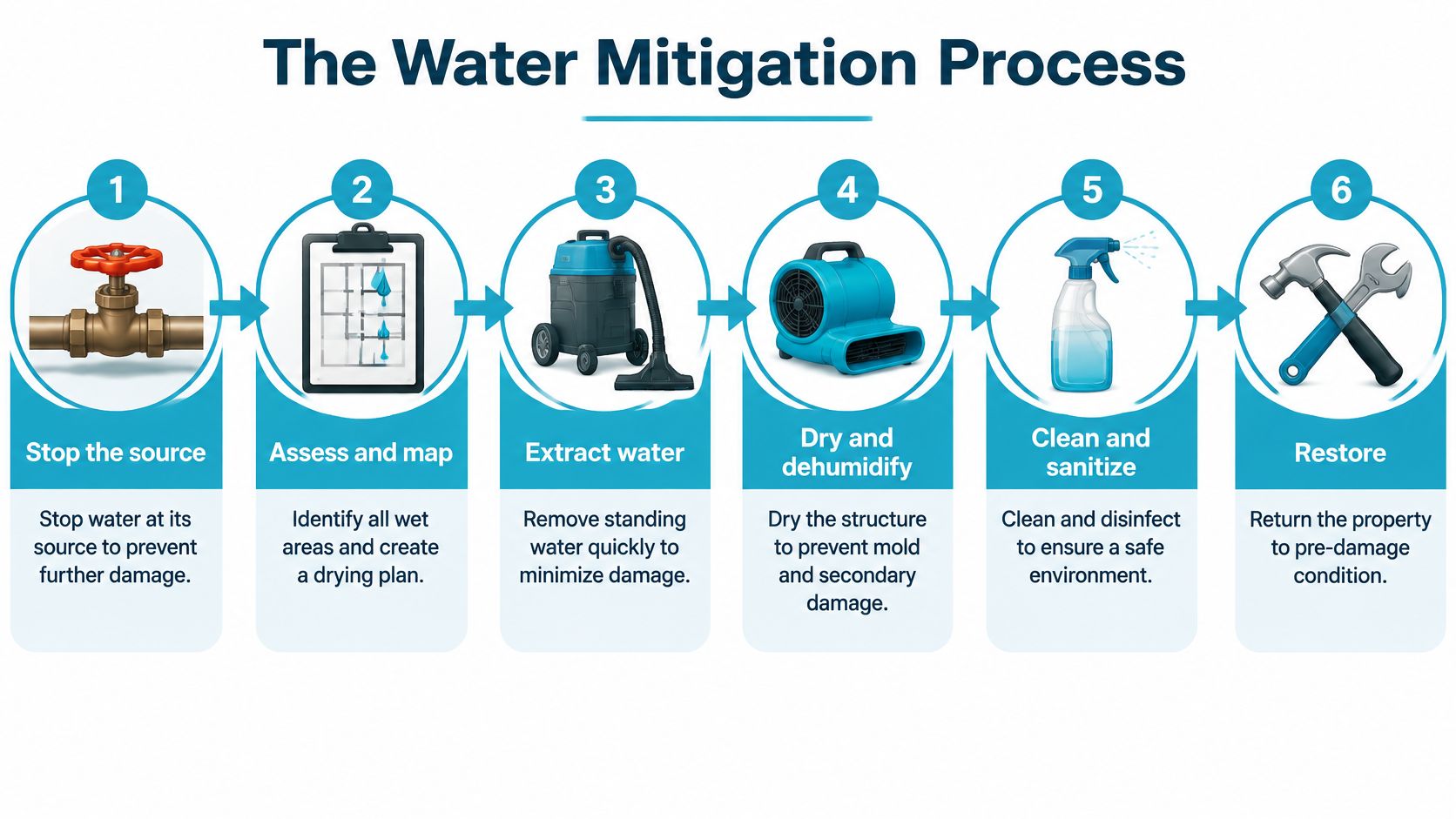
Stop the source. Shut the supply valve, kill the appliance, or cap the line, then repair the actual defect. Drying a structure that keeps receiving water never finishes, and an unfixed source is the most common reason a job drags past schedule.
Assess and map the moisture. Walk the loss with a moisture meter and a thermal camera. Water travels sideways and downward inside wall cavities, under flooring and through insulation, so the visible puddle tells you where the water started, not where it went. The slip here is trusting the eyeball test.
Extract the standing water. Pumps and industrial vacuums move the bulk; extraction wands pull water from carpet and its backing. Every gallon removed mechanically is a gallon the dehumidifiers don't have to chase through the air.
Move the air. Air movers set across wet surfaces speed evaporation. Heat helps in some assemblies but deserves caution on hardwood, where excessive heat can damage the wood. Placing a wall of fans with no plan just recirculates the same damp air.
Control the humidity. Dehumidifiers remove water from the building, because evaporation only continues while the air can keep accepting vapor. A room full of air movers and no dehumidifier pushes moisture into the framing instead of out of the house.
Monitor and document. Take readings in the wet areas and in an untouched reference area, photograph equipment placement, and log numbers daily. Readings that won't move after two days mean the drying plan isn't working, not that the meter is broken.
Clean, sanitize and remove what won't dry. Wash hard surfaces with detergent and water, deodorize, and pull porous materials such as ceiling tiles, carpet and padding when they can't be dried or cleaned. Leaving soaked padding in place is how a water job becomes a mold job.
The technical backbone is the IICRC S500 Standard for Professional Water Damage Restoration, which treats mitigation as applied psychrometry and drying technology rather than visible water removal. That's the difference between a crew with a wet-dry vac and a crew with a drying plan.
Trying to run these seven steps alone is where a lot of homeowners get hurt, and the reasons not to DIY water damage restoration usually announce themselves on day three, when the wall behind the baseboard starts to smell.
Those seven steps map onto the five stages in the comparison table above: emergency mitigation covers steps one through three, drying verification covers four through six, sanitization is step seven, and permanent restoration and reconstruction begin only once the readings hold steady.
Drying Benchmarks That Show a Job Is Complete
| Check | Benchmark | Why It Matters |
|---|---|---|
| Indoor relative humidity | Below 60%, ideal 30 to 50% | Keeps mold growth risk low |
| Wet carpet and backing | Dry within 24 to 48 hours | Mold risk rises after this window |
| Material wet longer than 48 hours | Handle under mold remediation guidance | Mold may already be established |
| Subfloor and wall cavities | Match unaffected reference readings | Visible dryness can hide trapped moisture |
| Hardwood floors | Dry with airflow and dehumidification, not heat | Excessive heat can damage the wood |
A floor that feels dry and a floor that is dry are two different things. The EPA's indoor air quality guidance on mold and moisture puts a number on the environment: indoor humidity should generally stay below 60%, with roughly 30 to 50% as the working target when possible. That gives you a threshold you can measure instead of a feeling you have to trust.
Fans and dehumidifiers do the accelerating. Opening windows only helps when the outside air is drier than the inside air, which on a Gulf Coast afternoon it rarely is.

Readings belong in several places, not one spot in the middle of the room, and each one needs comparing against an unaffected reference area such as a hallway wall or a closet floor that never got wet. Drying is a psychrometric control problem in the EPA's mold course treatment of moisture and drying: liquid water comes out first, then the remaining moisture has to evaporate from materials and leave the air, which takes air movement and dehumidification running together. One room reading tells you about that room. It says nothing about the assembly under it.
The two places visible dryness lies most often are the subfloor beneath vinyl or tile and the bottom foot of a wall cavity behind baseboard. A Sarasota kitchen is the classic case: the counter and tile feel bone dry two days after a dishwasher line split, while the subfloor underneath still reads wet enough to keep a mold risk alive.
The verdict test: the job is done when every tested point holds steady at a dry reading, the numbers haven't crept up overnight, and the source has been repaired and confirmed.
Our technicians monitor moisture levels throughout drying to make sure every part of the home reaches acceptable dryness standards, and equipment doesn't get pulled on a hunch. For a closer look at how assemblies get dried rather than just surfaces, see these structural drying methods.
Special Cases Where Mitigation Gets Harder
An air-conditioning condensate line clogs during an August heat wave in Sarasota. The unit keeps running, the pan overflows, and water soaks behind the drywall of a condo hallway for a week before anyone notices a stain near the ceiling. Three situations turn a job like that into something harder than a burst pipe.
Dirty Water Changes the Job
Sewage backups, rising groundwater and washing machine discharge can carry chemical or biological pollutants, and ordinary drying stops being enough. The EPA's brief guide to mold, moisture and your home is clear that containment and appropriate personal protective equipment come first, before anyone thinks about equipment placement. That's the logic behind containing a dirty loss: the same air movers that speed evaporation in clean water would spread contaminants through this one.
Past the Two-Day Mark
Once materials stay wet beyond 48 hours, or mold is already visible, the project shifts from prevention to remediation, as the EPA's mold course guidance separates the two. Absorbent materials such as carpet and ceiling tiles may need replacement, while hard surfaces can generally be cleaned with detergent and water and dried completely. This is the hidden cost of the 48-hour clock: a carpet reached at hour 30 is a drying job, and the same carpet at hour 60 can be a demolition job.
Moisture That Returns
A damp spot that comes back after drying means the source was never solved. The same EPA guidance tells building owners to check leaks, condensation, humidity levels, maintenance problems and HVAC issues, because unresolved moisture brings the problem straight back. Drying the stain twice still leaves you with a stain.
Florida adds its own pressure. Storm-driven intrusion often arrives with warm, saturated air that slows evaporation and shortens the margin before microbial growth begins. Say a Bradenton home takes on water in February and that same home takes on water in July: the July job starts the drying race with wetter air and less room for error, even before the first extractor arrives.
Rule of thumb: if the water is dirty, the materials have been wet for more than two days, or the damp spot comes back, stop and bring in a professional before you keep going.
Mold doesn't announce itself on a schedule you can see, and the mold growth timeline after water damage shows why waiting out a suspicious damp patch is a gamble.
Insurance, Documentation and Who Pays
Covered damage and necessary mitigation are two separate questions, and treating them as one costs homeowners money. An insurer may dispute the cause of a loss or push back on later repairs while still expecting you to take reasonable steps to limit secondary damage. So you act first and document as you go, not the other way around.
- Photograph before you move anything. Wide shots of the room, close shots of the water line, and pictures of anything you have to discard.
- Keep records of damaged items. Model numbers, receipts, or a written list made while the item is still in front of you.
- Notify the carrier promptly. Report the loss even if the water dried on its own, because the next crew and the next owner of the property will want the record.
- Ask whether emergency work is authorized. Get the answer in writing when you can, and don't let a pending answer delay work that prevents further damage.

Then there's the coverage distinction that surprises people. FEMA notes that most homeowners and renters policies generally do not cover flood damage, and that flood insurance typically carries a 30-day waiting period before it takes effect, as outlined in FEMA's guidance on flood insurance coverage. The National Flood Insurance Program limits look like this:
| Property Type | Building Coverage | Contents Coverage |
|---|---|---|
| Single-family residential | Up to $250,000 | Up to $100,000 |
| Renters | Not applicable | Up to $100,000 |
| Commercial structure | Up to $500,000 | Up to $500,000 |
Low mapped risk isn't the same as no exposure. FEMA's flood risk guidance explains that flood risk can exist outside high-risk zones and recommends reviewing flood maps and considering flood insurance even where the map looks calm.
For water damage claims, we work closely with the insurance provider and supply the documentation the file requires. If you're unsure what your carrier will want, this walkthrough of how to file an insurance claim for water damage covers the paperwork sequence.
Common Questions About Water Mitigation
Does mitigation remove mold that's already growing?
No. Mitigation prevents growth by controlling moisture. Established mold needs remediation, with containment, cleaning and removal of porous materials that can't be saved.
Can a homeowner just run fans and a dehumidifier?
Yes for a small, clean spill that dries within a day. Not for contaminated water, moisture hiding inside a wall cavity, or a leak that keeps coming back.
How long does mitigation take? Minor incidents often wrap in a few days, while damage with hidden moisture runs longer. The drying benchmarks decide when the job ends, not the calendar.
Why does the floor still feel damp after drying? Because trapped moisture under flooring or inside a wall can outlast the surface. Readings have to be taken there, not just in the middle of the room.
Is a leak that dried in one day still worth reporting? Yes. The insurer and any future repair crew need a record of the source and how it was handled, and a claim denied today can look different with documentation attached.
What's the first-hour priority? Shut off the source, keep people away from electrical hazards, and start removing standing water. Everything else follows from those three.
Understanding what water mitigation is changes how fast you move, and moving fast is most of the outcome.
Call for a Free Inspection and Estimate Today
Mitigation is a race measured in hours. Water that reaches wall cavities, subfloors and insulation keeps working long after the visible surface looks dry, and that trapped moisture is what pushes a job from minor repairs, which can run around $1,000, into extensive restoration that can exceed $10,000. If water is in your home right now, AMPM Restoration Services is available 24/7 with a one-hour response time, and the inspection and estimate are free.
The IICRC-certified team serves Bradenton, Sarasota, Palmetto, St. Petersburg and the greater Tampa Bay area. Water damage specialists arrive promptly after you call to assess the extent of the damage, with emergency dry-out as the first service on site.
Have three things ready before the crew arrives:
- Photos of the damage, taken before anything is moved or discarded
- Your insurance policy number, so the claim can be opened without delay
- The suspected water source, whether that's an appliance, a supply line, a roof or storm intrusion
AMPM coordinates directly with insurance carriers and provides the documentation claims require, and financing options are available for larger projects. If you're still sorting out what water mitigation means for your situation, an inspection answers it with moisture readings taken inside floors and wall cavities rather than guesses based on how the carpet feels. Visit AMPM Restoration Services to book your free inspection and stop the drying clock while there is still more to save than to replace.